Mегève. The kind of place you carry with you.
It was a morning in January. Maybe five o'clock, maybe half past — I can't remember exactly. What I do remember is the bedroom window, the shutter slightly ajar, and that cold blue light filtering across the floorboards.
I got up without waking anyone. I pulled on my jacket, eased the door open, and stepped outside.
Megève was asleep.
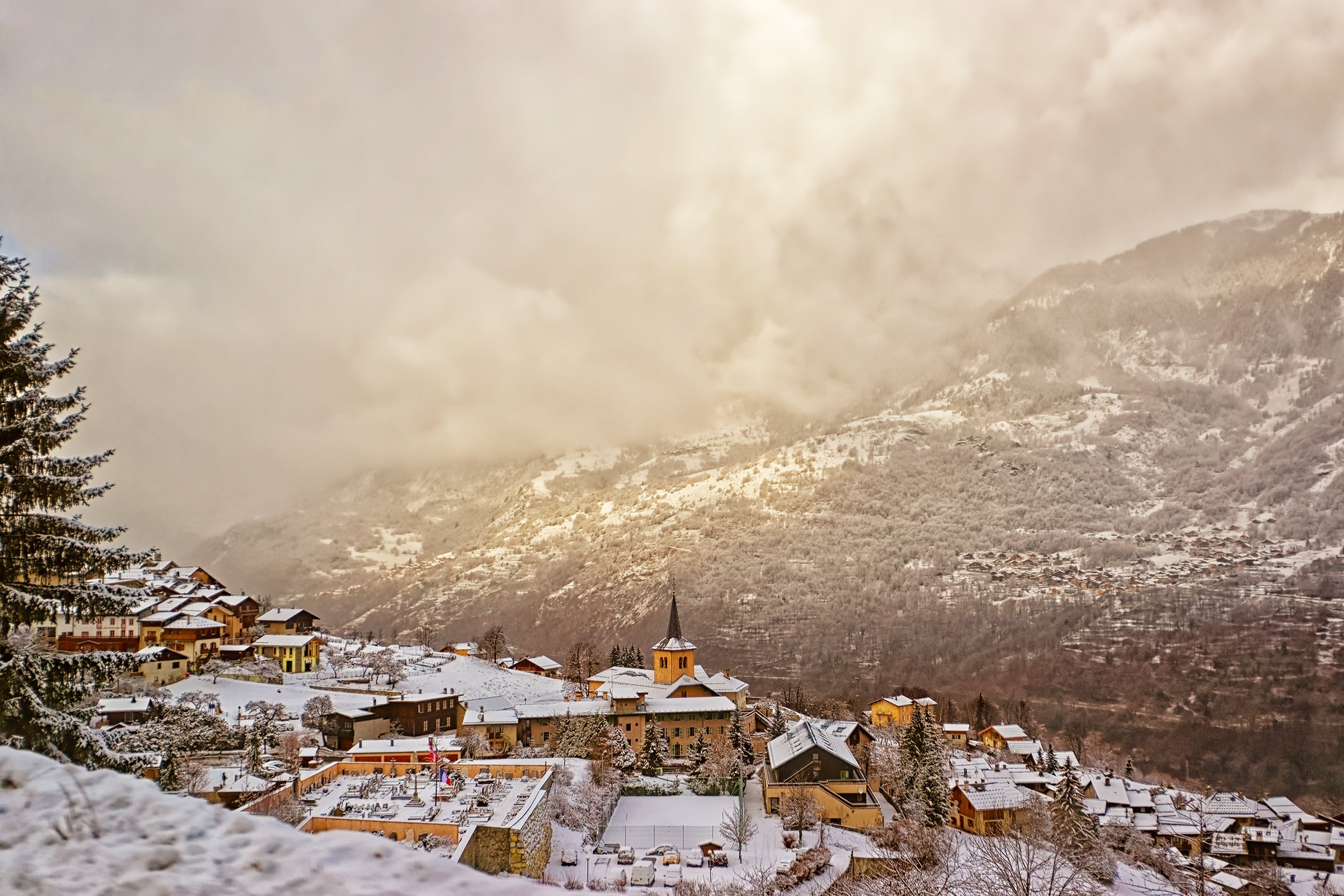
The village streets were empty, blanketed in fresh snow that swallowed every sound. The chalet facades, their frozen geraniums, their dark timber frames — everything was still. The cold was dry and clean, the kind that bites your nose and wakes something animal inside you.
I walked to the church square. And there, I looked up.
A cirque that holds you
What struck me wasn't any single summit. It was the whole. The way Megève sits in its cirque, ringed on all sides by dark masses that were just beginning to whiten at their crests in the first light. The Mont d'Arbois to the west, still in shadow. Mont-Joly further off, higher, its silhouette cut against a sky shifting from midnight blue to pearl grey. And Rochebrune, straight ahead — familiar, almost reassuring, as if it had always kept watch over the village.
There are places that do that. That wrap around you without warning.
I'd skied dozens of times in bigger, more famous resorts. But Megève, that morning, gave me something the others hadn't: the feeling of being in a hollow of the world, sheltered, far from everything. The valley is narrow just enough. The summits are close just enough. Nothing overwhelms, nothing is too small. Everything is on a human scale.
Time suspended
I stayed a long time on that square. The first lights of the bakeries began to appear. A delivery van crossed the village slowly. A dog barked somewhere up on the slopes.
And I stood there, watching those summits wake — the Alpette, the Mont-Joux, the Aiguille Croche in the distance. Names I hadn't yet learned at that point, that I looked up later on a map to put words to what I'd seen.
It's often like that with places that matter. You live them first. You understand them later.
What the lines hold
When I look today at the topographic illustration of Megève — those hundred lines tracing the valley from north to south, drawing the shoulders of Mont-Joly, the gentle slopes of Mont d'Arbois, the hollow where the village nestles — I find exactly that feeling from the January morning.
Not a photograph. Not a map. Something between the two.
The lines don't show Megève as it is. They show Megève as it feels: a mountain hollow, a geography that shelters, a relief that says you're here, you can breathe.
A place you carry
I don't know if everyone has a place like Megève in their memory. A place where the body remembers before the mind understands. A place you carry with you long after you've gone home.
If so, you already know what I'm talking about.
And if Megève isn't that place yet — maybe it's time to go.